

What does Apollo.io do?
- Searches and exports contacts and accounts with verified emails, mobile numbers, firmographics, job changes and intent topics.
- Runs email sequences from Apollo itself (2 sequences on Free, unlimited on paid plans), with a deliverability suite, email warmup and domain and mailbox purchasing on paid plans.
- Enriches CRM, CSV and API records automatically, with waterfall enrichment across 20+ third-party data partners on paid plans.
- Includes a US dialler (billed in credits), call recording, website visitor identification and lead scoring, with limits that rise by plan.
- Offers an Apollo MCP server for Claude, ChatGPT, Cursor and other MCP-compatible tools, plus an API on paid plans.
Where does Apollo.io fit in a GTM engineering stack?
Apollo is the contact database and all-in-one prospecting step in a GTM engineering stack: it supplies people and company records with emails and phones, and can sequence them itself or feed Clay as one data source.
- 1Search Apollo for accounts and contacts matching your ICP filters
- 2Pull them into Clay with Apollo's Find People or Enrich Person actions
- 3Fill missing emails or phones with other waterfall providers such as Prospeo
- 4Add contacts to an Apollo sequence or sync them to HubSpot or Salesforce
See how every layer connects in Clay integrations: how the GTM engineering stack fits together.
How do you use Apollo.io?
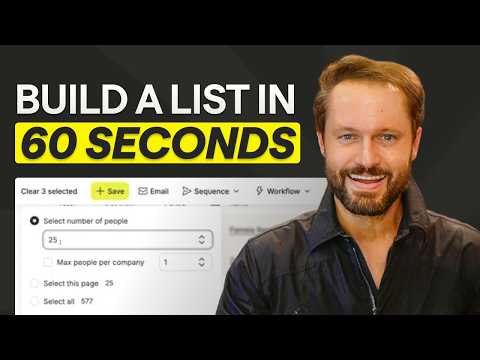
Apollo.io's official walkthrough, from the Apollo YouTube channel.
How much does Apollo.io cost?
Prices as shown on Apollo.io's pricing page on 17 October 2026 (USD). Free plan: Yes. Free: $0, 900 credits per seat per year granted monthly (75 per month), 2 sequences, basic filters, CRM enrichment (100 per month), Gmail mailboxes only, 150 minutes of call recording. Free trial: 14-day trial on Basic and Professional; Apollo's FAQ says the trial includes 75 credits and access to most features of the selected plan.
Free
$0
Free
900 credits per seat per year, granted monthly.
Basic
$49 per seat/month (annual) or $65 per seat/month (monthly)
Annual (save 24%) or monthly
Annual: 30,000 credits per seat per year, granted upfront. Monthly: 2,500 credits per seat per month. Unlimited sequences, CRM integrations, waterfall enrichment, 5 automated workflows.
Professional
$79 per seat/month (annual) or $99 per seat/month (monthly)
Annual or monthly
Annual: 48,000 credits per seat per year. Monthly: 4,000 credits per seat per month. Adds AI lead scoring, A/Z testing, 4,000 minutes of call recording and AI insights.
Organization
$119 per seat/month (annual) or $149 per seat/month (monthly)
Annual or monthly, minimum 3 seats
Annual: 72,000 credits per seat per year. Monthly: 6,000 credits per seat per month. 12 intent topics, 8,000 minutes of call recording, unlimited inbound routers.
Inbound add-on
Essentials $119/mo or Max $639/mo per team
Billed annually
Website visitor identification, lead routing, form builder and form enrichment.
Advanced Dialer add-on
$119 per team/month
Billed annually
International, parallel and power dialling, local presence.
Credit costs shown on the pricing page: email 1 credit, phone number 8 credits, data enrichment 1 to 8 credits, AI research 1 credit per run, US dialler 1 credit per 30 seconds. Credits are pooled across the team and do not roll over. Prices exclude tax. Apollo labels add-on pricing as introductory and subject to change. The page's FAQ also mentions a 'Custom' plan with SSO and API access via sales.
Who is Apollo.io best for?
A good fit if you
- Small teams and individual sellers who want contact data and a sequencer in one seat-priced tool, starting at $49 per seat per month billed annually.
- Founders testing outbound on the free plan, which includes 900 credits per seat per year (granted monthly) and 2 sequences.
- Teams running Salesforce, HubSpot, Microsoft Dynamics or Zoho CRM that want automated CRM enrichment on paid plans.
- GTM engineers who want Apollo data inside Clay, since Clay lists 14 native Apollo actions using your own Apollo account.
Look elsewhere if you
- Teams that need more than one CRM connected, because Apollo's knowledge base says you can only connect one CRM at a time.
- Teams relying on unused credits carrying forward: Apollo says plan and add-on credits expire at the end of each billing cycle.
- Mixed-seat teams, since all seats on an account must be on the same plan.
- Anyone planning to resell or embed Apollo data in an external product, which needs a separate custom agreement.
Does Apollo.io integrate with Clay and your CRM?
- Clay
- Native Clay integration. Clay lists a native Apollo.io integration with 14 actions, including Enrich Person, Enrich Company, Find People, Find People at Company by Job Title, Find Open Jobs and Add Contact to Sequence. Each action is marked 'Bring Your Own Account Required', so you connect your own Apollo account. (source)
- Integrations
- Apollo integrates natively with Salesforce, HubSpot, Microsoft Dynamics and Zoho CRM (one CRM connected at a time), Gmail and Outlook mailboxes, Slack, Adobe Marketo and Clay, and offers an MCP server for Claude, ChatGPT, Cursor and Replit. Sequencing is built in rather than handed to a separate sequencer. (source)
- GDPR
- Apollo's privacy policy says it relies mainly on legitimate interests for its contributor database, acts as controller for database data and processor for customer data, and lets EEA and UK individuals object or opt out via its removal page, after which it keeps a suppression list. It states ISO 27001 and SOC 2 certification, participates in the EU-US Data Privacy Framework and UK Extension while primarily relying on Standard Contractual Clauses, offers a customer DPA, and names EEA and UK representatives. (source)
- Data coverage
- Apollo says it has 240M+ contacts and 30M+ accounts with verified B2B data, combines 20+ third-party data partners, and offers 65+ data points per contact and account. These are vendor-reported figures; its integrations directory elsewhere says 275+ million verified contacts. (source)
What are the best Apollo.io alternatives?
Other data providers that do the same job in a GTM engineering stack, with their own trade-offs.

B2B contact data provider for verified work emails and mobile numbers, with people search, CSV and API enrichment and CRM sync.
- Pricing
- Free plan; paid from $37/user/mo
- Free trial
- None listed

Waterfall contact enrichment across 25+ data sources for verified work emails, personal emails and mobile numbers, pay per result.
- Pricing
- $26/mo (annual)
- Free trial
- Free trial: $0, 50 credits, no credit card, full Pro feature set; extra credits by inviting team members.

GTM data platform that combines 150+ data providers, AI research agents and workflow automation in spreadsheet-style tables.
- Pricing
- Free; paid from $167/mo (annual)
- Free trial
- 14-day trial offered on the Free, Launch and Growth plans.
Apollo.io FAQs
Is Apollo.io free?
Yes, Apollo has a free plan with no time limit. It includes 900 credits per seat per year (granted monthly), 2 sequences and basic filters, and email campaigns can only use Gmail accounts. When a paid trial ends you can upgrade or move to the free plan.
How do Apollo credits work?
Apollo credits are pooled across your team and granted at the start of each billing cycle. A verified email costs 1 credit and a phone number costs 8 credits. Unused credits, including purchased add-on credits, expire at the end of the cycle.
Is Apollo.io GDPR compliant?
Apollo says it processes database contacts under legitimate interests and lets EEA and UK individuals object or request removal. It states ISO 27001 and SOC 2 certification and uses Standard Contractual Clauses for transfers. Whether your own outreach is lawful still depends on your legitimate interest assessment and opt-out handling.
Can I connect Apollo to more than one CRM?
No, Apollo's knowledge base says you can connect only one CRM at a time. If Salesforce is connected, you must disconnect it before connecting HubSpot. Supported CRMs include Salesforce, HubSpot, Microsoft Dynamics and Zoho CRM.
Does Apollo work with Clay?
Yes, Clay has a native Apollo.io integration with 14 actions, from enriching people and companies to adding contacts to Apollo sequences. You connect your own Apollo account, so lookups use your Apollo plan rather than Clay data credits.
Compare and learn
- Clay alternatives in 2026: what to use instead, by use case
- Clay vs Apollo: pricing, data and which one you need
- Clay integrations: how the tools fit into a GTM engineering system
- Clay pricing in 2026: every plan, credit and worked cost example
- The GTM tech stack: layers, tools, costs and how they connect
- Waterfall enrichment: how it works, how to build one and what it costs
- How to choose data providers
Want a GTM engineering system built for you?
Tentt builds signal-driven outbound, enrichment and CRM systems into B2B companies' stacks. Or start free with the resources from every video.
Sources
Checked on 17 October 2026.
Pricing, integrations and data policies are checked against Apollo.io's own pages. How we research tools.