

What does FullEnrich do?
- Runs waterfall enrichment across 25+ third-party sources so one provider missing a contact does not end the search.
- Verifies emails (syntax, SMTP and catch-all deep checks with a confidence score) and checks phones for landlines and out-of-service numbers.
- Offers people and company search, reverse email lookup and bulk CSV enrichment.
- Provides a REST API with webhook or polling results, an MCP server for Claude, ChatGPT and Cursor, and agent skills on GitHub.
- Includes unlimited users on every plan, with per-user credit limits and low-credit alerts on Pro.
Where does FullEnrich fit in a GTM engineering stack?
FullEnrich is the waterfall contact-enrichment step in a GTM engineering stack: it checks 25+ sources for a contact's verified work email, personal email and mobile number, and charges only for results found.
- 1Clay or a CSV supplies a contact's name and company domain or LinkedIn URL
- 2FullEnrich runs its own waterfall across 25+ sources and verifies each email and phone
- 3Enriched contacts sync to HubSpot or return to Clay through the integration or API
- 4Clay routes verified contacts to a sequencer such as lemlist or Smartlead
See how every layer connects in Clay integrations: how the GTM engineering stack fits together.
How do you use FullEnrich?
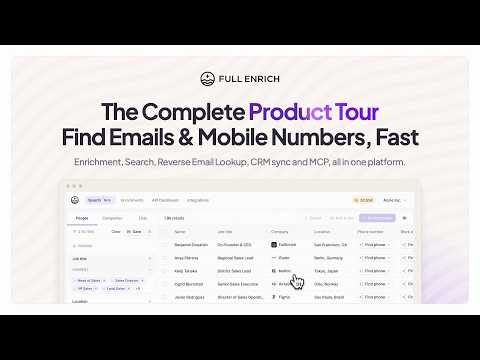
FullEnrich's official walkthrough, from the FullEnrich YouTube channel.
How much does FullEnrich cost?
Prices as shown on FullEnrich's pricing page on 17 October 2026 (USD). Free plan: No ongoing free plan; a free trial gives 50 credits to start. Free trial: Free trial: $0, 50 credits, no credit card, full Pro feature set; extra credits by inviting team members.
Free trial
$0
One-off
50 credits, no credit card required.
Pro (monthly)
From $29/mo
Monthly
Credit tiers: 500 for $29, 750 for $42.75, 1,000 for $55, 1,500 for $79.50, 2,000 for $104, 5,000 for $255, 10,000 for $499, 15,000 for $720, 25,000 for $1,150, 50,000 for $1,950, 100,000 for $3,500. Over 100,000: contact sales. Credits roll over 3 months.
Pro (annual)
From $26/mo ($312/yr)
Billed yearly, roughly 10% cheaper
Credit tiers per year: 6,000 for $312, 12,000 for $588, 24,000 for $1,128, 60,000 for $2,784, 120,000 for $5,448, up to 1,200,000 for $37,800. Credits roll over 12 months.
Enterprise
Custom
Contact sales
Priority support, custom rate limits, dedicated account manager, flexible billing, BYOK, custom SSO add-on, reseller and agency options.
Credit costs: work email 1, personal email 3, mobile phone 10, reverse email lookup 1, person and company profile 0.25 on its own (free with any enrichment). Lookups that find nothing, and landlines found instead of mobiles, cost nothing. FullEnrich publishes the same tiers in a machine-readable file at fullenrich.com/pricing.md.
Who is FullEnrich best for?
A good fit if you
- Teams that want waterfall enrichment through one API and one bill instead of contracting several providers directly.
- Teams with many users, since every plan includes unlimited users and pricing never scales per seat.
- Irregular usage: unused credits roll over for 3 months on monthly plans and 12 months on annual plans.
- Clay users who want FullEnrich's work email and mobile lookups inside a Clay table, on Clay credits or their own account.
Look elsewhere if you
- Teams needing native sync with CRMs other than HubSpot; FullEnrich lists HubSpot as its CRM integration.
- Phone-heavy workloads on a small budget, because each mobile number costs 10 credits.
- Teams wanting sequencing, signals or outreach automation in the same tool; FullEnrich focuses on enrichment and search.
- Enterprises needing custom SSO, BYOK or custom rate limits without a sales contract, as these are Enterprise-only.
Does FullEnrich integrate with Clay and your CRM?
- Clay
- Native Clay integration. Clay lists a Clay-built FullEnrich integration with two actions: Find Work Email with FullEnrich (from name and company domain or name) and Find Mobile Phone with FullEnrich. Both run on Clay credits or your own FullEnrich account. (source)
- Integrations
- FullEnrich lists a native HubSpot CRM integration, Clay, Zapier, Make and n8n, plus an MCP server and connectors for Claude, OpenAI, Manus and OpenClaw, and a REST API. It does not list native sequencer integrations; you route results through Clay or automation tools. (source)
- GDPR
- FullEnrich's privacy and legal centre states SOC 2 Type II certification, GDPR and CCPA compliance and a public DPA covering GDPR Article 28. It says data is hosted in the EU, transfers outside the EEA and UK use Standard Contractual Clauses, waterfall results are deleted from customer accounts after three months, and it does not keep its own database for waterfall enrichment. It acts as processor for waterfall enrichment and as controller, relying on legitimate interests, for People and Company Search. Individuals can opt out through its portal. (source)
- Data coverage
- FullEnrich says it queries 25+ data sources in its waterfall, that its search covers 800M people and 50M companies, and that its average email find rate is about 80%, varying by region and seniority. It also says roughly 30% of raw data is removed by verification. These are vendor figures. (source)
What are the best FullEnrich alternatives?
Other data providers that do the same job in a GTM engineering stack, with their own trade-offs.

B2B contact data provider for verified work emails and mobile numbers, with people search, CSV and API enrichment and CRM sync.
- Pricing
- Free plan; paid from $37/user/mo
- Free trial
- None listed

B2B contact database with built-in sequencing, dialler, CRM enrichment and AI research, priced per seat with pooled credits.
- Pricing
- Free; paid from $49/seat/mo (annual)
- Free trial
- 14-day trial on Basic and Professional; Apollo's FAQ says the trial includes 75 credits and access to most features of the selected plan.

GTM data platform that combines 150+ data providers, AI research agents and workflow automation in spreadsheet-style tables.
- Pricing
- Free; paid from $167/mo (annual)
- Free trial
- 14-day trial offered on the Free, Launch and Growth plans.
Which GTM stacks use FullEnrich?
FullEnrich FAQs
Is FullEnrich free?
FullEnrich has a free trial rather than a permanent free plan. The trial gives 50 credits with no credit card and full access to Pro features, and you can earn extra credits by inviting team members. Paid Pro plans start at $29/mo for 500 credits.
How does FullEnrich waterfall enrichment work?
FullEnrich queries 25+ data sources one after another for each contact and returns verified results. Emails pass syntax, SMTP and catch-all checks, and phones are checked for landlines and out-of-service numbers. You are only charged credits when verified data is found.
Do FullEnrich credits expire?
FullEnrich credits roll over rather than expiring at the end of each cycle. Unused credits carry forward for 3 months on monthly plans and 12 months on annual plans.
Is FullEnrich GDPR compliant?
FullEnrich states it complies with GDPR and CCPA and is SOC 2 Type II certified. It hosts data in the EU, offers a public DPA and deletes waterfall results from customer accounts after three months. Individuals can opt out through its portal.
Can I use FullEnrich in Clay?
Yes, Clay has a native FullEnrich integration for finding work emails and mobile numbers. You can pay with Clay credits or connect your own FullEnrich account, which bills against your FullEnrich credits instead.
Compare and learn
- Clay alternatives in 2026: what to use instead, by use case
- Clay integrations: how the tools fit into a GTM engineering system
- Clay pricing in 2026: every plan, credit and worked cost example
- Cold email deliverability in 2026: domains, authentication, warm-up and monitoring
- The GTM tech stack: layers, tools, costs and how they connect
- How to choose data providers
Want a GTM engineering system built for you?
Tentt builds signal-driven outbound, enrichment and CRM systems into B2B companies' stacks. Or start free with the resources from every video.
Sources
Checked on 17 October 2026.
Pricing, integrations and data policies are checked against FullEnrich's own pages. How we research tools.