
What does MillionVerifier do?
- Sells one-time credit packs from $39 for 10,000 ($0.0039 each) to $8,499 for 50 million, with no subscription and no expiry on paid credits.
- Sorts results into ok, catch_all, unknown, invalid and disposable, and its catch-all verifier claims to resolve 30% to 40% of catch-all addresses for one regular credit (vendor figure).
- Returns goodwill credits for risky results (unknown and unresolved catch-all) across all verification methods; its terms say these have no cash value.
- Offers a money-back guarantee if more than 4% of qualifying ok addresses hard bounce because the address did not exist, under the conditions in its terms.
- Lets API calls set a timeout of 2 to 60 seconds (default 20) for slow recipient servers.
- Runs EverClean, which verifies new contacts every day inside Mailchimp, HubSpot or ActiveCampaign, and lists 40+ integrations.
Where does MillionVerifier fit in a GTM engineering stack?
MillionVerifier is the low-cost verification pass in a GTM engineering stack: it sits after the Clay email waterfall and before the sequencer, and its catch-all check decides which risky rows are worth sending.
- 1Clay finds one email per contact through a waterfall such as LeadMagic, then Prospeo
- 2Validate Emails with MillionVerifier returns ok, catch_all, unknown, invalid or disposable
- 3ok rows push to Smartlead or Instantly; invalid and disposable rows are suppressed
- 4catch_all rows go to a separate low-volume campaign; unknown rows are re-run later, with risky results credited back
See how every layer connects in Clay integrations: how the GTM engineering stack fits together.
How do you use MillionVerifier?
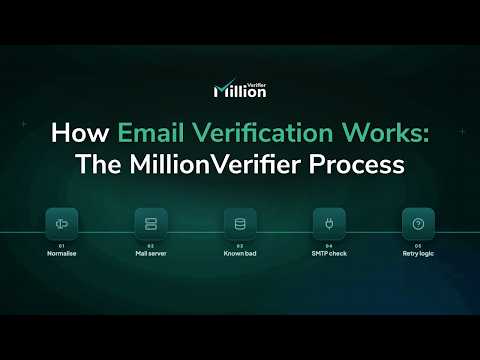
MillionVerifier's official walkthrough, from the MillionVerifier YouTube channel.
How much does MillionVerifier cost?
Prices as shown on MillionVerifier's pricing page on 17 October 2026 (USD). Free plan: 100 free verification credits when you create an account, no credit card required.
10,000 to 50,000 credits
$39 for 10,000; $59 for 25,000; $89 for 50,000 ($0.00178 each)
One-time purchase
Credits never expire.
100,000 to 1,000,000 credits
$149 for 100,000; $299 for 500,000; $449 for 1,000,000
One-time purchase
2,000,000 to 5,000,000 credits
$799 for 2,000,000; $1,099 for 3,000,000; $1,399 for 4,000,000; $1,599 for 5,000,000
One-time purchase
10,000,000 to 50,000,000 credits
$2,599 for 10,000,000; $4,999 for 25,000,000; $8,499 for 50,000,000
One-time purchase
Volume pricing available above 50 million.
Prices are the one-time packages in the pricing slider on millionverifier.com on 17 October 2026 (the site's pricing section is on the home page; /pricing returned a 404). The same credits work for single checks, CSV lists, bulk, API and ESP integrations. The site advertises a "full refund" on risky emails, while the Terms of Service describe risky-result credits as a discretionary goodwill programme with zero cash value.
Who is MillionVerifier best for?
A good fit if you
- High-volume list cleaning on a budget: 1 million credits cost $449, and 25 million cost $4,999.
- Teams verifying in bursts, since paid credits do not expire just because time passes.
- Cold email stacks already on Smartlead or Reply, both listed among MillionVerifier's integrations.
Look elsewhere if you
- Clay users on the Free or Launch plans: Clay lists the MillionVerifier action as Growth and above, and it needs your own MillionVerifier account.
- Buyers who need named certifications: the site footer says "SOC 2 Controls" but the pages reviewed do not cite a SOC 2 report or ISO certificate.
- Teams wanting deliverability extras such as inbox placement tests or warm-up in the same tool; MillionVerifier focuses on verification.
Does MillionVerifier integrate with Clay and your CRM?
- Clay
- Native Clay integration. Clay lists MillionVerifier as a Clay-built integration on Growth and above, with one action, Validate Emails with MillionVerifier, which flags invalid, risky and catch-all contacts and returns Email Validity Status. You need your own MillionVerifier account. (source)
- Integrations
- 40+ integrations including HubSpot, Pipedrive, Zoho CRM, Freshsales, Mailchimp, ActiveCampaign, SendGrid, Mailgun, Intercom, Reply, Smartlead, Klenty and Snov.io, plus a REST API and a custom app option. (source)
- GDPR
- MillionVerifier is run by GBD Software as a Service, Lakitelek, Hungary, and offers a DPA on every plan, including free. The DPA says uploaded and result files are normally deleted within 30 days, addresses may sit in an operational cache for up to 7 days, cached data is not used for model training, and customer data is not used to build data products for other customers. Subprocessors are listed on a separate page. (source)
What are the best MillionVerifier alternatives?
Other deliverability tools that do the same job in a GTM engineering stack, with their own trade-offs.

Email verification with seven result statuses, AI scoring for risky addresses, EU-hosted processing and free unknowns.
- Pricing
- Free 100/mo; credits from $39
- Free trial
- None listed

ZoomInfo-owned email verification with five result codes, bulk and real-time checks, and Sync for automatic CRM list cleaning.
- Pricing
- $8 per 1,000 credits (one-time)
- Free trial
- Free test credits and a free list analysis; the pricing page does not state the number of credits.
Which GTM stacks use MillionVerifier?
- Lean cold email stack for small teamsRole: Re-checks the exported list just before upload and flags catch-all and risky addresses, so only clean rows reach the sequencer.
- Signal-based outbound stackRole: Final check before sending, run from Clay's MillionVerifier action (Growth and above), flagging invalid, risky and catch-all addresses.
MillionVerifier FAQs
Do MillionVerifier credits expire?
No. MillionVerifier's terms say paid credits do not expire merely because time passes, and inactivity does not cause them to be forfeited. Promotional credits also do not expire unless an expiry date was disclosed when they were granted.
Does MillionVerifier charge for catch-all emails?
MillionVerifier returns goodwill credits for risky results, meaning unknown and catch-all addresses it cannot resolve, across all verification methods. Its terms describe this as a discretionary programme and say those credits have no cash value.
How does the MillionVerifier money-back guarantee work?
The terms say it applies if more than 4% of qualifying ok addresses hard bounced because the address did not exist, and the account complies with the terms. If the conditions are met, MillionVerifier refunds the most recent qualifying payment for paid credits.
Which Clay plan do I need for MillionVerifier?
Clay lists the MillionVerifier integration as Growth and above, and it requires your own MillionVerifier account. On lower Clay plans, ZeroBounce and NeverBounce are listed as available on all plans.
Is 1 million email verifications really $449?
Yes. MillionVerifier's pricing slider shows 1,000,000 credits for $449 as a one-time purchase, about $0.00045 per email. Larger packs fall further, to $8,499 for 50 million.
Compare and learn
Want a GTM engineering system built for you?
Tentt builds signal-driven outbound, enrichment and CRM systems into B2B companies' stacks. Or start free with the resources from every video.
Sources
Checked on 17 October 2026.
Pricing, integrations and data policies are checked against MillionVerifier's own pages. How we research tools.